


GET UP TO 15% DISCOUNT!
Sign up now as a CBS member & enjoy our royal discounts!
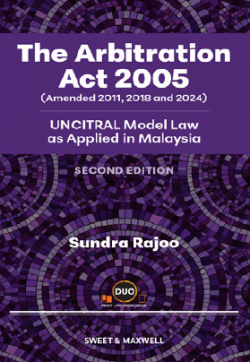
The Arbitration Act 2005: UNCITRAL Model Law as Applied in Malaysia - 2nd Ed
- Publication Date : Jul - 2026
- Author : Sundra Rajoo
- ISBN : 9786297851396
- Format : Print + eBook
- Country : Malaysia
The authoritative commentary on Malaysia’s arbitration statute
Since its enactment, the Arbitration Act 2005 has been amended four times, most recently in 2024 to introduce the new section 9A on the law applicable to an arbitration agreement, the third party funding regime in sections 46A to 461, and the new institutional appointing-authority architecture. The Federal Court has, over two decades, given the Act its developed jurisprudential content. The Act that a practitioner reads today is materially different from the Act that was enacted 20 years ago.
This commentary is the authoritative reading. The second edition treats each provision of the Act as it now stands, sets out the legislative history of its amendments, identifies the Malaysian case law that has construed it, reads it against the UNCITRAL Model Law and the corresponding provisions in the leading Model Law jurisdictions, and notes the points on which the law is settled and those on which it continues to develop. The result is a single volume to which the Bench, the Bar, the institutional community and the academic reader can turn for the current and authoritative reading of each section of the Arbitration Act 2005.
Readers familiar with the author’s Handbook on Arbitration (Thomson Reuters, 2026) will recognise the subject matter but find a different book. Where the Handbook is organised around the life cycle of an arbitration – the agreement, the tribunal, the proceedings, the award, the courts and enforcement, this commentary is organised around the Arbitration Act itself, section by section. The two volumes are companions. The Handbook is the practitioner’s working reference when conducting an arbitration; this commentary is the practitioner’s authority on the statute that governs it. Together they give the Malaysian arbitration community a complete library on the law and practice of arbitration in this country.
Comprehensive Coverage
Introductory Overview
Provides an insightful overview of arbitration in Malaysia and the relevant statutory developments.
Part I • Preliminary (ss 1–2)
Short title and commencement; interpretation; the scope and application of the Act to domestic and international arbitrations seated in Malaysia.
Part II • Arbitration (ss 3–46I)
Receipt of communications; arbitrability; arbitration agreements including the new section 9A on the law applicable to an agreement; stay of court proceedings; interim measures; composition and jurisdiction of the tribunal; conduct of proceedings; the award and its making; setting aside; recognition and enforcement; appeals on questions of law; costs and fees; third party funding under the new sections 46A to 46I; and the role of the courts at each stage.
Part III • Additional Provisions Relating to Arbitration (ss 47–51)
The additional provisions applicable to international and domestic arbitration; consolidation; determination of preliminary points of law; the powers of the court.
Part IV • Miscellaneous (ss 52–56)
Liability of arbitrators; immunity of appointing authorities; banking secrecy; bankruptcy; consequential and supplementary provisions; repeal and saving.
Format of Commentary
- The text of the section as it stands in 2026, with the 2011, 2018 and 2024 amendments incorporated.
- The Model Law equivalent (with the article number and any divergences identified).
- Legislative history: the original 2005 provision and the path through the 2011, 2018 and 2024 amendments.
- Malaysian case law: Federal Court, Court of Appeal and High Court decisions construing the section, set out chronologically with the principles drawn.
- Comparative materials: leading authorities on the corresponding provisions in Singapore, Hong Kong, Australia, Canada and England.
- Practical observations: the questions that practitioners and tribunals most frequently encounter on the section, with the author’s analysis.
The Arbitration Act 2005: UNCITRAL Model Law as Applied in Malaysia - 2nd Ed
The authoritative commentary on Malaysia’s arbitration statute
Since its enactment, the Arbitration Act 2005 has been amended four times, most recently in 2024 to introduce the new section 9A on the law applicable to an arbitration agreement, the third party funding regime in sections 46A to 461, and the new institutional appointing-authority architecture. The Federal Court has, over two decades, given the Act its developed jurisprudential content. The Act that a practitioner reads today is materially different from the Act that was enacted 20 years ago.
This commentary is the authoritative reading. The second edition treats each provision of the Act as it now stands, sets out the legislative history of its amendments, identifies the Malaysian case law that has construed it, reads it against the UNCITRAL Model Law and the corresponding provisions in the leading Model Law jurisdictions, and notes the points on which the law is settled and those on which it continues to develop. The result is a single volume to which the Bench, the Bar, the institutional community and the academic reader can turn for the current and authoritative reading of each section of the Arbitration Act 2005.
Readers familiar with the author’s Handbook on Arbitration (Thomson Reuters, 2026) will recognise the subject matter but find a different book. Where the Handbook is organised around the life cycle of an arbitration – the agreement, the tribunal, the proceedings, the award, the courts and enforcement, this commentary is organised around the Arbitration Act itself, section by section. The two volumes are companions. The Handbook is the practitioner’s working reference when conducting an arbitration; this commentary is the practitioner’s authority on the statute that governs it. Together they give the Malaysian arbitration community a complete library on the law and practice of arbitration in this country.
Comprehensive Coverage
Introductory Overview
Provides an insightful overview of arbitration in Malaysia and the relevant statutory developments.
Part I • Preliminary (ss 1–2)
Short title and commencement; interpretation; the scope and application of the Act to domestic and international arbitrations seated in Malaysia.
Part II • Arbitration (ss 3–46I)
Receipt of communications; arbitrability; arbitration agreements including the new section 9A on the law applicable to an agreement; stay of court proceedings; interim measures; composition and jurisdiction of the tribunal; conduct of proceedings; the award and its making; setting aside; recognition and enforcement; appeals on questions of law; costs and fees; third party funding under the new sections 46A to 46I; and the role of the courts at each stage.
Part III • Additional Provisions Relating to Arbitration (ss 47–51)
The additional provisions applicable to international and domestic arbitration; consolidation; determination of preliminary points of law; the powers of the court.
Part IV • Miscellaneous (ss 52–56)
Liability of arbitrators; immunity of appointing authorities; banking secrecy; bankruptcy; consequential and supplementary provisions; repeal and saving.
Format of Commentary
- The text of the section as it stands in 2026, with the 2011, 2018 and 2024 amendments incorporated.
- The Model Law equivalent (with the article number and any divergences identified).
- Legislative history: the original 2005 provision and the path through the 2011, 2018 and 2024 amendments.
- Malaysian case law: Federal Court, Court of Appeal and High Court decisions construing the section, set out chronologically with the principles drawn.
- Comparative materials: leading authorities on the corresponding provisions in Singapore, Hong Kong, Australia, Canada and England.
- Practical observations: the questions that practitioners and tribunals most frequently encounter on the section, with the author’s analysis.
GET UP TO 15% DISCOUNT!
Sign up now as a CBS member & enjoy our royal discounts!