


GET UP TO 15% DISCOUNT!
Sign up now as a CBS member & enjoy our royal discounts!
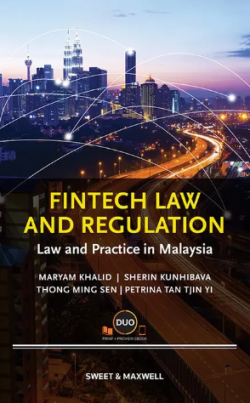
Fintech Law and Regulation Law and Practice in Malaysia
- Publication Date : Oct - 2026
- Author : Maryam Khalid, Sherin Kunhibava, Thong Ming Sen & Petrina Tan Tjin Yi
- ISBN : 9786297851556
- Format : Print + eBook
- Country : Malaysia
“The book provides a thoughtful analysis of the legal principles, regulatory architecture, and policy considerations that shape the Fintech landscape, while addressing many novel legal issues arising from technological innovation. It fills a significant gap in the literature on Fintech regulation …”
From the Foreword by
Tan Sri Zarinah Anwar
Chairman of the Board of Directors, Universiti Malaya
Fintech Law and Regulation serves as an essential, pioneering resource designed to map the rapidly evolving financial technology landscape of Malaysia with comparative reference to developments principally in Singapore, Indonesia, and Thailand. This text provides a sophisticated comparative analysis of the diverse innovation-friendly policies and risk-based oversight strategies shaping the ASEAN region.
The volume is structured into nine comprehensive chapters that address a critical gap in current legal literature. It meticulously guides readers through the region’s distinct regulatory challenges – ranging from cross-border compliance and data protection to anti-money laundering (AML) efforts. Key chapters delve into early and emerging Fintech paradigms, including alternative fundraising via crowdfunding, distributed ledger technology (DLT), smart contracts, decentralised autonomous organisations (DAOs), and the legal boundaries governing digital assets, cryptocurrency, and e-money licensing.
What truly distinguishes this book from other works is its groundbreaking examination of Islamic Fintech. Highlighting Malaysia’s global leadership, it contrasts Shariah-compliant digital instruments with conventional Fintech, supported by targeted case studies across Malaysia, Singapore, and Indonesia. Moving into modern frontiers, the book evaluates the impactful rollout of licensed digital banking consortiums driving financial inclusion, alongside the regulatory governance of artificial intelligence applications like robo-advisers. Concluding with a deep dive into regulatory sandboxes, the text offers a clear, strategic way forward for managing a fragmented digital ecosystem.
Purposefully crafted to be both exhaustive and accessible, this book is an indispensable reference for law and finance students, academic researchers, and policymakers navigating the legal foundations and changing paradigms of regional Fintech governance.
Key Features
- Comparative analysis of regulatory frameworks, compliance challenges, and risk-based oversight strategies.
- Survey of cutting-edge tech governance addressing next-generation compliance realities.
- Real-world case studies grounded in practical application.
- Pioneering Islamic Fintech coverage.
- Examination of forward-looking regulatory solutions.
Fintech Law and Regulation Law and Practice in Malaysia
“The book provides a thoughtful analysis of the legal principles, regulatory architecture, and policy considerations that shape the Fintech landscape, while addressing many novel legal issues arising from technological innovation. It fills a significant gap in the literature on Fintech regulation …”
From the Foreword by
Tan Sri Zarinah Anwar
Chairman of the Board of Directors, Universiti Malaya
Fintech Law and Regulation serves as an essential, pioneering resource designed to map the rapidly evolving financial technology landscape of Malaysia with comparative reference to developments principally in Singapore, Indonesia, and Thailand. This text provides a sophisticated comparative analysis of the diverse innovation-friendly policies and risk-based oversight strategies shaping the ASEAN region.
The volume is structured into nine comprehensive chapters that address a critical gap in current legal literature. It meticulously guides readers through the region’s distinct regulatory challenges – ranging from cross-border compliance and data protection to anti-money laundering (AML) efforts. Key chapters delve into early and emerging Fintech paradigms, including alternative fundraising via crowdfunding, distributed ledger technology (DLT), smart contracts, decentralised autonomous organisations (DAOs), and the legal boundaries governing digital assets, cryptocurrency, and e-money licensing.
What truly distinguishes this book from other works is its groundbreaking examination of Islamic Fintech. Highlighting Malaysia’s global leadership, it contrasts Shariah-compliant digital instruments with conventional Fintech, supported by targeted case studies across Malaysia, Singapore, and Indonesia. Moving into modern frontiers, the book evaluates the impactful rollout of licensed digital banking consortiums driving financial inclusion, alongside the regulatory governance of artificial intelligence applications like robo-advisers. Concluding with a deep dive into regulatory sandboxes, the text offers a clear, strategic way forward for managing a fragmented digital ecosystem.
Purposefully crafted to be both exhaustive and accessible, this book is an indispensable reference for law and finance students, academic researchers, and policymakers navigating the legal foundations and changing paradigms of regional Fintech governance.
Key Features
- Comparative analysis of regulatory frameworks, compliance challenges, and risk-based oversight strategies.
- Survey of cutting-edge tech governance addressing next-generation compliance realities.
- Real-world case studies grounded in practical application.
- Pioneering Islamic Fintech coverage.
- Examination of forward-looking regulatory solutions.
GET UP TO 15% DISCOUNT!
Sign up now as a CBS member & enjoy our royal discounts!